
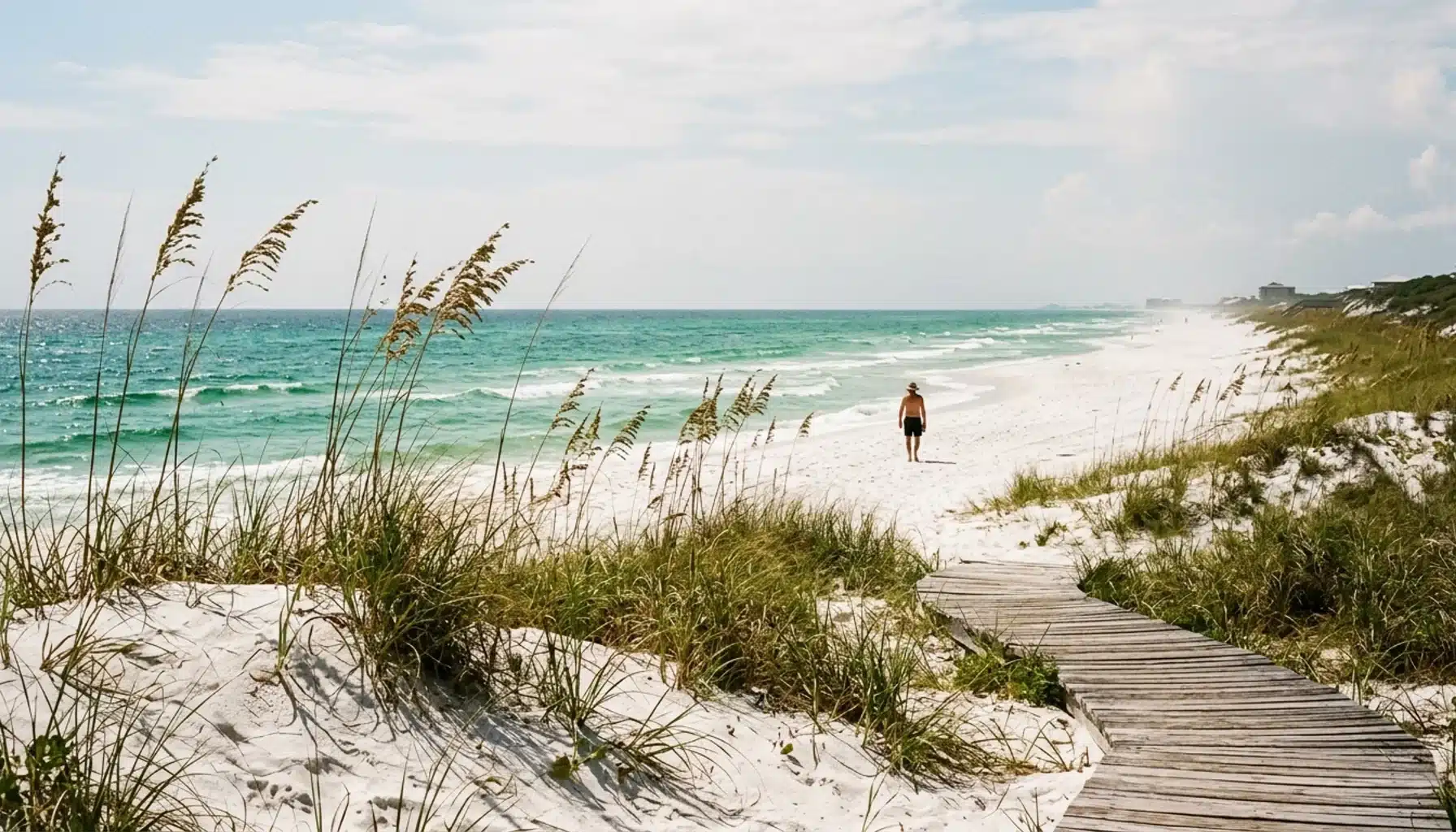
The best time to visit Blue Mountain Beach is May or late September through early October, when Gulf water temperatures sit in the high 70s to low 80s, crowds thin out from summer peaks, and nightly rental rates drop from the moderately high summer tier to average or below. If you need guaranteed warm water and don’t mind paying peak rates, June and July still deliver.
Key Takeaways
- May offers a high of 83°F, a mean temperature of 75°F, and 3.21 inches of average precipitation, making it the sweet spot between spring chill and summer humidity, according to timeanddate.com climate data.
- Peak season runs Memorial Day through Labor Day, with July and August both averaging 90°F highs and roughly 6.2 inches of monthly rainfall.
- Vrbo’s seasonal occupancy table lists May, June, and July as High occupancy with Moderately High pricing, while January sits at Low occupancy and Moderately Low pricing.
- Walton County drew 2,056,800 visitors in summer 2026, spending $1,558,484,300 directly in the county, though that was down 6.2% from summer 2026, per Walton County Tourism’s Summer 2026 Visitor Tracking Study.
- Hurricane season runs June through November regionally, with the most storm activity historically concentrated in August through October, so travel insurance and flexible cancellation terms matter most during those months.
- Families booking a 3 to 5 bedroom home like Ocean Breeze in Blue Mountain Beach should target May or the last two weeks of September for the best mix of warm water, manageable crowds, and rates below the summer ceiling.
Blue Mountain Beach sits along Scenic Highway 30A in Walton County, and it holds a distinction most visitors never learn: it rises roughly 64 feet above sea level, the highest point on the Emerald Coast, according to Callista Vacations. That elevation gives the neighborhood its name and its slightly different feel from flatter beach towns nearby. If you’re trying to time a family trip, a girls’ weekend, or a multi-generational reunion here, the calendar matters as much as the guest list.
This guide breaks the year into real, usable chunks: weather by month, water temperature, crowd patterns, pricing tiers, and hurricane risk, the stuff most “best time to visit” articles gloss over with a generic “spring and fall are nice.” As a host based directly in Blue Mountain Beach, I’ve watched bookings, weather, and foot traffic shift across every month for years, and the patterns are more specific than most guides let on.
Whether you’re chasing warm water for toddlers, a quiet beach for a work-from-anywhere stretch, or the cheapest week that still has decent weather, the month you pick changes almost everything about the trip. Below is the month-by-month breakdown, followed by a decision framework built around what actually matters to you.
What Is the Best Month to Visit Blue Mountain Beach and Why?
May is the single best month to visit Blue Mountain Beach for most travelers, combining a warming Gulf, average highs of 83°F, and pricing that hasn’t yet hit the summer ceiling. Late September through early October runs a close second, trading a slightly cooler ocean for noticeably thinner crowds and lower nightly rates.
May works because school is still in session for most of the country through mid-month, which keeps the beach access points and restaurants like Mimmo’s and Cowgirl Kitchen workable without a wait past 6:30pm. Vrbo’s seasonal data classifies May as High occupancy with Moderately High pricing, but that’s relative to the rest of the year, not the July peak. Specifically, rates in May typically run below what you’d pay for the same house over a July 4th week.
Late September gives you the other half of the equation. Kids are back in school, humidity has started to break, and the mean temperature drops to 80°F with less oppressive afternoon storms than August. As a result, beach chairs are easier to find, parking near the Blue Mountain Regional Beach Access opens up, and restaurant reservations become optional rather than mandatory.
What Are Weather Conditions Like Each Month at Blue Mountain Beach?
Blue Mountain Beach weather follows a clear arc: cool and dry from December through February, warming steadily through spring, peaking in heat and humidity from June through September, then cooling again into a mild, drier fall. Rainfall spikes sharply in summer and tapers off by October.
January is the coldest month, with a high of 62°F, a low of 44°F, and a mean of 53°F, according to timeanddate.com. That’s still mild compared to most of the country, which is why the “Tourist Checklist” guide to the area frames winter as a genuinely pleasant, low-crowd option rather than a season to avoid.
By May, highs climb to 83°F and lows sit around 67°F, with 3.21 inches of average precipitation. Adagio30A describes spring in Blue Mountain Beach as running March through June, with highs between 75 and 85 degrees and lows dipping to 54 at the season’s cooler edge in March.
Summer brings the heat and the rain together. July and August both average 90°F highs with mean temperatures of 83°F, and each month sees more than 6 inches of rainfall, mostly in short, predictable afternoon thunderstorms. September holds onto summer warmth, 87°F highs and an 80°F mean, but rainfall stays high at 6.30 inches before dropping to 3.62 inches in October as highs ease to 80°F.
| Month | Average High | Average Low | Mean Temp | Avg. Precipitation |
|---|---|---|---|---|
| January | 62°F | 44°F | 53°F | Lower |
| May | 83°F | 67°F | 75°F | 3.21 in |
| July | 90°F | 76°F | 83°F | 6.18 in |
| August | 90°F | 76°F | 83°F | 6.25 in |
| September | 87°F | 72°F | 80°F | 6.30 in |
| October | 80°F | 63°F | 72°F | 3.62 in |
Data via timeanddate.com climate averages near Blue Mountain Beach. For real-time forecasts closer to your travel dates, AccuWeather and NOAA both publish updated regional models worth checking a week out.

When Are Crowds Highest and Lowest at Blue Mountain Beach?
Crowds peak at Blue Mountain Beach from Memorial Day through Labor Day, with the heaviest weeks falling around July 4th and the first two weeks of August. The lowest crowd levels run from mid-January through February and again in the first half of November, after the fall shoulder season tapers off.
Summer 2026 brought 2,056,800 visitors to Walton County, generating over $1.5 billion in direct spending, according to the Walton County Tourism Summer 2026 Visitor Tracking Study. That’s the scale of foot traffic you’re competing with for beach chairs and restaurant tables in June, July, and August. Spring 2026 saw 1,303,900 visitors and $1,145,805,400 in direct spending, a noticeably lighter load that still supports a full slate of open restaurants and activities.
Blue Mountain Beach itself has just two public beach accesses conveniently placed in the neighborhood’s core, according to Visit South Walton. That’s a small footprint compared to larger 30A communities, which means even a moderately busy summer weekend can feel tight at the main access points by mid-morning. Families who arrive after 10am in July often end up parking farther out and walking longer.
Weekday visits consistently run lighter than weekends, and that gap widens in shoulder months. If your schedule allows a Tuesday through Friday stay in late September rather than a weekend arrival, you’ll notice the difference immediately at both the beach access and at walkable spots like Red Fish Taco.
How Do Prices Vary by Season at Blue Mountain Beach?
Rental pricing at Blue Mountain Beach follows demand closely, with summer commanding the highest nightly rates and January through February offering the lowest. Vrbo’s seasonal pricing table lists May through July as Moderately High, October as Average, and November and January as Moderately Low to Low.
Summer 2026 lodging data for the broader market reported an average room rate of $504.21 and a RevPAR of $343.37, reflecting strong summer pricing across Walton County’s measured lodging market. Visitors spent an average of $141 per day in summer 2026, down from $156 the prior summer, while spring 2026 visitors averaged $145 per day. Fall 2026 saw daily visitor spending climb to $156, with the typical travel party spending $607 per day and $3,720 across the entire trip.
For a 3 to 5 bedroom home built for a family or multi-generational group, that pricing swing between June and October can be substantial. Booking a shoulder-season week doesn’t just mean fewer crowds; it typically means a materially lower total trip cost once you factor in the nightly rate difference across a five to seven night stay. Pricing and availability vary by property and should always be confirmed directly with the listing before booking.
Booking direct also affects your total cost regardless of season. Guests who book directly with a host return to book again 28.3% of the time, compared to just 8.9% through Airbnb, according to hostAI’s 2026 booking data, largely because direct relationships skip third-party platform markups.
When Is Hurricane Season and How Does It Affect Beach Visits?
Hurricane season along the Gulf Coast runs from June through November, with the highest historical storm activity concentrated in August, September, and October. Blue Mountain Beach rarely takes a direct hit in any given year, but named storms and tropical systems can bring rough surf, rip currents, and occasional evacuation advisories during peak months.
This is the single biggest planning gap most Blue Mountain Beach guides skip entirely. If you’re booking a trip for September, specifically, build in trip insurance or confirm the property’s cancellation policy before paying a deposit. Rainfall data backs this up too: September posts the highest average precipitation of the year at 6.30 inches, partly a function of tropical moisture moving through the region.
NOAA tracks storm formation and regional advisories in real time, and checking their NOAA tropical outlook a week before travel is a smarter habit than relying on a static seasonal guide. Local emergency guidance and evacuation routes are managed at the county level, so confirm current advisories with Walton County’s official channels if a storm is tracking toward the Panhandle during your travel window.
In practice, most hurricane season weeks pass without any disruption at all. Late September and early October, in fact, often deliver some of the calmest, most pleasant beach days of the year, once you’re past a named storm’s path. The trade-off is a slightly higher chance of a rescheduled day versus visiting in April or May.
Summer vs Spring vs Fall: Which Season Should You Book?
Spring, summer, and fall each solve a different travel priority at Blue Mountain Beach: spring balances warmth and value, summer guarantees the warmest water and busiest energy, and fall trades a few degrees of water temperature for noticeably thinner crowds and lower rates.
Summer is the only season with consistently warm Gulf water from opening day to Labor Day, which matters most for families with younger kids who won’t tolerate a cool ocean. It’s also the loudest, busiest, and most expensive season, with July and August both averaging 90°F air temperatures and the year’s heaviest visitor volumes.
Spring, running roughly March through June per Adagio30A’s seasonal framing, offers the best value-to-comfort ratio. May specifically threads the needle: warm enough water, manageable crowds, and pricing below peak summer. Spring also brings wildflowers blooming through Point Washington State Forest and lupins covering the dunes, according to Oversee’s coverage of the area, a nice bonus for anyone adding a hike to the trip.
Fall, particularly late September into October, is the pick for travelers who prioritize quiet over guaranteed warm water. Crowds drop noticeably after Labor Day, and the Blue Mountain Regional Beach Access rarely fills up the way it does in July.
| Season | Water Temp Feel | Crowd Level | Pricing Tier | Best For |
|---|---|---|---|---|
| Spring (Mar-Jun) | Warming, comfortable by May | Moderate, rising in June | Moderate to Moderately High | Families wanting value plus warmth |
| Summer (Jun-Aug) | Warmest of the year | High, peaks around July 4th | Moderately High | Guaranteed warm water, full activity calendar |
| Fall (Sep-Oct) | Still warm through Sept, cooling by Oct | Low to Average | Average | Quiet beaches, lower rates, storm-watch needed |
| Winter (Nov-Feb) | Cool, not swim-friendly for most | Low | Low to Moderately Low | Budget trips, walking, dining without crowds |
What Is the Water Temperature at Blue Mountain Beach by Month?
Gulf water temperature at Blue Mountain Beach stays swim-comfortable from roughly May through early October, with the warmest stretch landing in July and August. Winter water temperatures drop enough that only the most cold-tolerant swimmers stay in for long, even on a warm-air day.
May’s air temperature mean of 75°F typically corresponds to Gulf water that’s comfortable for extended swimming, though mornings can still feel brisk before the sun warms the shallows. By July and August, with air means at 83°F, the Gulf itself reaches its warmest annual temperatures, ideal for young kids and anyone who wants to skip the “getting used to it” phase entirely.
September holds onto much of that warmth even as air temperatures start easing toward an 80°F mean, which is part of why late September works so well as a shoulder-season pick: you get summer-warm water without the summer crowd. October’s water starts cooling alongside the air’s drop to a 72°F mean, and by winter, swimming becomes a cold-tolerance activity rather than a daily plan.
If warm water is your top non-negotiable, prioritize June through mid-September and accept the higher crowd and price tier that comes with it.
What Fun Things Are There to Do at Blue Mountain Beach?
Blue Mountain Beach offers three rare coastal dune lakes, Little Redfish Lake, Big Redfish Lake, and Draper Lake, along with two public beach accesses and easy proximity to state parks, making it a strong base for families who want beach days broken up with paddling, hiking, and local food. Redfish Village anchors a small shopping and dining cluster right at the neighborhood’s center.
Big Redfish Lake is a favorite for kayaking and paddleboarding, since the dune lake’s calmer, brackish water suits kids better than open Gulf surf on a windy day. Grayton Beach State Park is a short drive west and adds a second dune lake, Western Lake, plus hiking trails through coastal scrub. Topsail Hill Preserve State Park sits nearby too, with its own dune lake system and a tram to the beach.
For food, the walkable cluster around Ocean Breeze includes Mimmo’s for wood-fired pizza, Cowgirl Kitchen for a market-cafe vibe good for breakfast before a beach day, Red Fish Taco for a casual dinner with kids, and 30A Creamery for the after-dinner ice cream walk that ends most family trips here. Rainy afternoons, which spike in July through September, are a good excuse to check out The Hidden Lantern Bookstore or plan a fishing charter through Deep Charters or Santa Rosa Charters for the next clear morning.

What Beaches Should You Stay Away From in Florida During Peak Season?
The beaches to approach carefully during peak season aren’t unsafe, they’re simply the heavily trafficked stretches near large hotel corridors and spring break hubs where parking, noise, and crowd density spike hardest between March and August. Blue Mountain Beach, by contrast, has stayed comparatively low-key because it has only two public beach accesses and no high-rise hotel strip.
Areas with dense hotel towers and a younger nightlife scene tend to see the sharpest spring break crowd surge, typically concentrated in March. If a quiet, family-paced beach matters more to you than nightlife, Blue Mountain Beach’s smaller footprint and residential character along Scenic Highway 30A make it a calmer choice than more built-up stretches of the Panhandle during that window.
That said, even Blue Mountain Beach gets genuinely crowded during the peak mid-June through early-August stretch and around July 4th specifically. If you’re visiting during those windows, arrive at the beach access before 9:30am to find parking and a decent stretch of sand, especially with kids and a full set of beach gear in tow.
Always check current rip current flags and swim advisories at any Gulf beach before letting kids swim unsupervised, since conditions can shift within a single day regardless of season.
How Far Is Blue Mountain Beach from Destin?
Blue Mountain Beach sits roughly 30 to 40 minutes east of Destin by car, depending on Highway 98 traffic, which tends to slow considerably during peak summer weekends and around shift-change hours at popular restaurants. The drive runs along Scenic Highway 30A and Highway 98, passing through Santa Rosa Beach along the way.
That proximity makes Destin’s larger attractions, deep-sea fishing charters, and shopping centers a reasonable day trip without requiring a change of lodging. For groups who want Destin’s bigger amenities during the day but a quieter home base at night, Blue Mountain Beach and neighboring Santa Rosa Beach offer that combination well. Traffic on 98 during July weekends can stretch that 30 to 40 minute drive noticeably longer, so build in extra time if you’re timing a dinner reservation.
How Does Spring Break Affect Blue Mountain Beach Crowds and Pricing?
Spring break brings a noticeable but shorter-lived crowd bump to Blue Mountain Beach, typically concentrated in March, with less impact than the sustained summer peak that runs June through August. Because the neighborhood lacks a large hotel or condo tower corridor, its spring break crowd stays lighter than more built-up 30A and Panhandle destinations.
Families traveling with school-age kids during a March spring break window should still expect fuller beach access parking on weekends and slightly elevated pricing compared to the quieter weeks in February or early April. As a result, if your dates are flexible, the first two weeks of April or the back half of May often deliver a calmer, better-value alternative to a peak spring break week, while still landing inside the warming spring weather window Adagio30A describes running March through June.
How Should You Choose the Right Month for Your Trip?
Choosing the right month comes down to ranking your own priorities: warm water, low crowds, low cost, or guaranteed sunshine, since no single month wins on all four. Use the framework below to match your trip type to the calendar.
- Prioritize warm water above all else: book June through August, and accept peak pricing and the heaviest crowds of the year.
- Prioritize value and moderate crowds: book May or the first half of June, when water is warming and pricing sits below the July ceiling.
- Prioritize quiet beaches over warm water: book late September through October, watch storm forecasts, and expect noticeably thinner crowds at both beaches.
- Prioritize the lowest possible cost: book January or February, understand swimming is a cold-tolerance activity, and focus the trip around dining, walking, and dune lake scenery instead.
- Traveling with a multi-generational group: book May or late September so grandparents get mild temperatures and kids still get warm-enough water, avoiding both peak summer heat and winter chill.
Common mistake to avoid: booking a September trip without checking storm forecasts or confirming a flexible cancellation policy, since that month carries both the year’s best crowd-to-warmth ratio and its highest hurricane season risk. Another common mistake is assuming July pricing applies year-round, when Vrbo’s own seasonal table shows a clear drop by October and again in winter.
Frequently Asked Questions
What is the best month to visit Blue Mountain Beach?
May is generally the best month, with warming Gulf water, a mean temperature of 75°F, and pricing below the summer peak. Late September is a strong second choice for travelers who prioritize quiet beaches over guaranteed warm water.
Is Blue Mountain Beach crowded in the summer?
Yes, summer is the busiest season, with the heaviest crowds around July 4th and the first two weeks of August. Walton County recorded over 2 million visitors in summer 2026 alone, and Blue Mountain Beach’s two public beach accesses fill up quickly on peak weekends.
When does hurricane season affect Blue Mountain Beach?
Hurricane season runs June through November, with the highest storm activity typically concentrated in August, September, and October. Direct hits are uncommon in any given year, but travelers booking during those months should check NOAA’s tropical outlook and confirm a property’s cancellation policy.
How far is Blue Mountain Beach from Destin?
Blue Mountain Beach is roughly 30 to 40 minutes from Destin by car via Highway 98, depending on traffic. Summer weekend traffic along Highway 98 can extend that drive time noticeably.
Is winter a good time to visit Blue Mountain Beach?
Winter offers the lowest crowds and lowest pricing of the year, with January highs around 62°F. Swimming isn’t practical for most visitors, but it’s a good season for walking, dune lake scenery, and quiet dining without a wait.
What is the water temperature like in the fall at Blue Mountain Beach?
Gulf water typically stays warm enough to swim comfortably through late September, even as air temperatures start easing. By October, both air and water begin cooling more noticeably, with average highs dropping to 80°F.
Does booking in the shoulder season save money on a Blue Mountain Beach rental?
Yes, shoulder season months like May and October typically carry lower nightly rates than the June through August peak, based on Vrbo’s seasonal pricing classifications for the area. Exact rates vary by property, so confirm current pricing directly with the listing.
Final Thoughts on Timing Your Blue Mountain Beach Trip
May and late September remain the two months that consistently deliver the best combination of warm water, manageable crowds, and pricing below the summer ceiling at Blue Mountain Beach. Summer still wins if guaranteed warm water and a full activity calendar matter more to your group than avoiding a crowd, and winter remains the budget-friendly, low-crowd option for travelers who don’t need to swim.
Whichever month you choose in 2026, build your beach days around the elevation and dune lake features that make Blue Mountain Beach different from flatter 30A neighborhoods, and check storm forecasts if you’re traveling in the September window. The right month depends less on a universal “best time” and more on which trade-off, warmth, cost, or quiet, matters most to your group this year.
If you’re timing a shoulder-season trip for warm water without the peak crowd, Ocean Breeze puts you a 10-minute walk from the sand and steps from Mimmo’s and Cowgirl Kitchen, no matter which month you land on. Check current dates and book direct here.
Content powered by inkSTR.co